Have you ever wondered how your bank magically knows that your Friday night swipe happened at a restaurant, not a retail store? You get your 5% reward instantly, while your friend using a different card gets a flat 1%.
Knowing what’s going on under the hood with credit cards is not necessarily a geek thing. To get the most out of your credit card rewards, it’s important to understand how your bank categorizes your credit card purchases.
The secret weapon behind this system is a tiny 4-digit number called an MCC (Merchant Category Code). Here is exactly how bank transaction categories work and how you can use this knowledge to optimize your credit card basket.
What is an MCC and How Credit Cards Work?
When a business in India, whether it’s an online giant like Amazon or your local grocery store, sets up its card swipe machine or online payment gateway, it is assigned a 4-digit Merchant Category Code (MCC) by payment networks like Visa, Mastercard, and RuPay.
This code serves as a universal ID that tells the banking system exactly what goods or services the business sells.
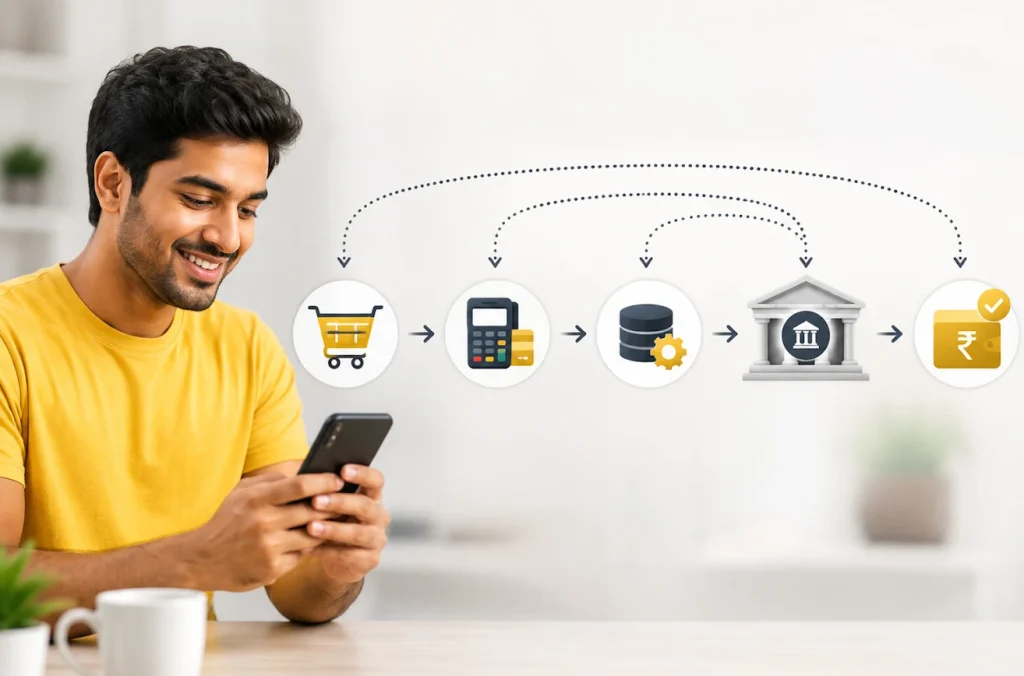
The Transaction Journey:
- You swipe your card or make an online payment.
- The merchant’s terminal sends the transaction amount along with its 4-digit MCC to the network.
- The card-issuing bank reads the MCC and automatically sorts it into specific bank transaction categories.
- If that category is eligible for accelerated points, the reward system triggers your payout.
For example, if you eat at a restaurant, the merchant likely operates under MCC 5812 (Eating Places and Restaurants). When your bank sees this code, it automatically classifies the transaction under the “Dining” bucket. Choosing the right cashback credit card for this specific category ensures you never miss a reward.
Quick Tip: Want to avoid annual fees entirely while building your stack? Check out our curated list of the best Lifetime Free Credit Cards in India that still offer great baseline category rewards.
Tracking the Core Credit Card Spending Categories
Every optimized cashback credit card has a specific rewards structure linked to these underlying codes. Let’s look at how banks track two major pillars found right here on Credit Card Basket:
1. The Travel Category
When you book a flight or a hotel, the system scans for specific MCC ranges. Airlines usually fall between MCC 3000–3299, while hotels occupy 3500–3999.
- The Catch: If you buy a sandwich at an airport cafe, the merchant code will likely register as Dining, not Travel. Even though you were physically traveling, you won’t get the travel-tier bonus rewards because the MCC (Merchant Category Code) governs the transaction.
2. The Shopping Category
Departmental stores, clothing shops, and electronics outlets have their own codes (e.g., MCC 5311 for Department Stores).
- The Catch: E-commerce giants like Amazon or Flipkart are trickier. They are often classified as “All-In-One” or Miscellaneous General Merchandise. This is why a co-branded cashback credit card like the Amazon Pay ICICI or Axis Flipkart card is so powerful—it bypasses generic category trackers to give you flat, elevated rewards specifically at those massive digital merchants.
Why Knowing “How Credit Card Rewards Work” Saves You Money?
The primary reason people miss out on returns is category confusion. A merchant might look like a grocery store to you, but if their payment processor classified them as a wholesale distributor, your bank won’t award you grocery points.
Furthermore, many banks have started excluding certain credit card spending categories (such as utility bills, rent, or fuel payments) from earning standard rewards.
Build the Ultimate “Credit Card Basket”
You can’t rely on just one cashback credit card. Because a single card will never give you maximum rewards across every MCC code, the smartest financial move is to build a tailored basket of cards:
- Pair a high-yielding card for your Travel Cards bookings to earn massive multipliers on airline and hotel MCCs.
- Anchor your food delivery app orders with a dedicated card for Dining Cards to maximize weekend restaurant spending.
- Combine it with an optimized card for your e-commerce and retail Shopping Cards expenditures to unlock flat merchant discounts.
Optimize Your Wallet with Credit Card Basket
Stop leaving money on the table. Now that you know the science of how banks track your money, it’s time to play the game to win.
Instead of guessing which cashback credit card matches which merchant category, use Credit Card Basket to instantly compare, combine, and select the perfect combination of cards for your lifestyle. Find the ultimate strategy for your unique spending profile in just one click!
Frequently Asked Questions
Banks usually don’t print MCC codes on standard receipts. However, you can see the exact transaction category name listed on your credit card monthly statement or inside your bank’s mobile app timeline after making a purchase.
No. Merchants cannot change their codes freely. MCCs are designated strictly by the acquiring bank and payment network (Visa/Mastercard/RuPay) based on the primary nature of the business.
Yes, sometimes. A business might use one merchant code for their brick-and-mortar storefront and a completely separate online payment aggregator gateway code for their website, resulting in different rewards.
Banks pay transaction processing fees to networks. Since profit margins on low-yield categories like fuel, utilities, insurance, and rent are extremely thin, most card issuers exclude them from regular cashback reward structures to cut costs.