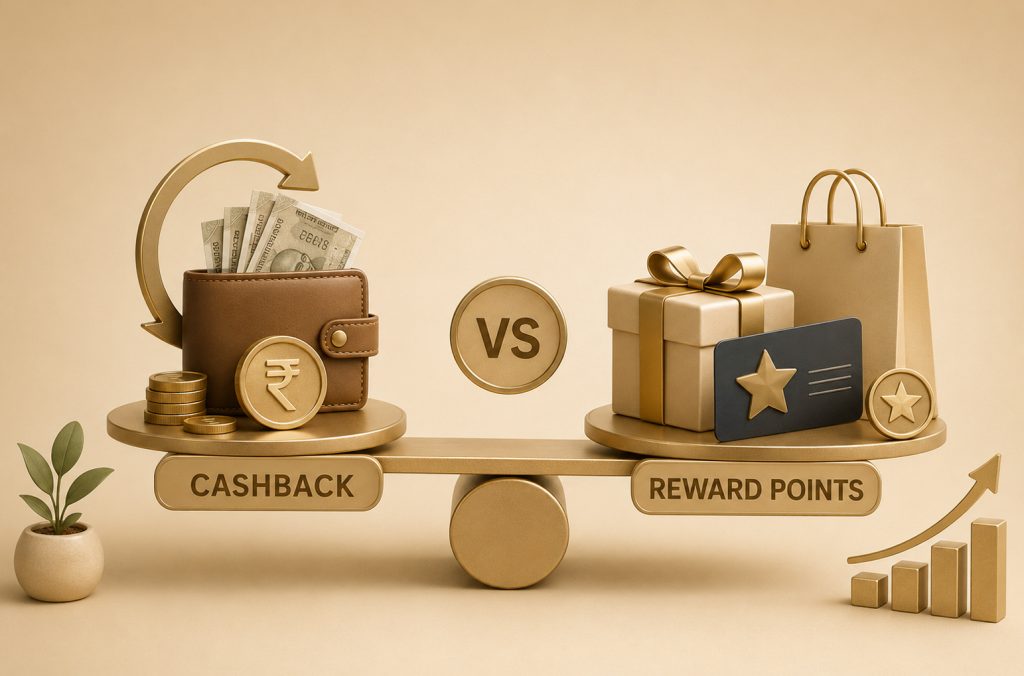
Walk into any conversation about credit cards in India, and it takes about three minutes before someone confidently declares that cashback is better than reward points, or the other way around. Both sides sound reasonable. Both sides are also missing the point entirely. The question was never which one is better in the abstract. The question is which one puts more money back in your pocket given the way you actually spend.
If you have not already mapped your spending to what your current card actually returns, our Rewards point calculator does that in under two minutes. That answer is different for almost every person reading this, and the only way to find it is to do the math rather than trust the marketing.
Before getting into the numbers, it helps to know what the best cashback credit cards in India currently look like and what they are competing against on the rewards side. The landscape in 2026 has shifted significantly after multiple issuers cut reward rates mid-year, which changes the comparison in ways that most existing guides have not caught up with yet.
What Cashback Actually is vs What Most People Think It is
Credit card cashback is straightforward in principle. You spend money, and a percentage comes back to you as a credit on your statement or directly into your account. No conversion. No redemption portal. No points-to-rupees calculation. The number on your statement is the number you get.
But the word “cashback” has been stretched so far in India that it now covers at least three different things that behave very differently in practice.
The first is true cashback: a direct percentage credited to your statement balance. The Axis ACE card‘s 5 percent on Google Pay bill payments and the HSBC Live+ card’s 10 percent on groceries and utilities work this way. You spend Rs. 10,000 on eligible categories; Rs. 500 or Rs. 1,000 lands on your statement automatically at month end. Nothing to do, nowhere to go.
The second is portal cashback: credited to a third-party app like Amazon Pay or a Paytm wallet rather than your statement. Technically cashback, but with a restriction on where you can spend it.
The third is CashPoints, which HDFC uses. These look like cashback and are marketed as cashback but are actually a points currency that converts to statement credit at Rs. 1 per CashPoint. The difference matters when there are monthly caps, because CashPoints caps limit how much cashback you can actually earn even if you spend well above the threshold.
Knowing which type your card uses changes how you evaluate it. True statement cashback is the cleanest and most flexible. Everything else involves a condition.
What Reward Points Actually Are and Where They Go Wrong
Reward points are the other side of the equation. You earn points on eligible spends and redeem them later through your bank’s rewards portal for vouchers, flights, hotel bookings, or statement credit. The complication is that reward points do not have a fixed value. The same 10,000 points on an HDFC Infinia card can be worth Rs. 2,000 as statement credit or Rs. 10,000 as a flight booking through SmartBuy. That is a 5x difference in value from the same points balance, entirely determined by how you choose to redeem.
This is where reward points beat cashback credit cards decisively for the right kind of user. A frequent traveller who knows how to spend HDFC Infinia points in the right manner on flights and hotel stays is getting an ROI that is till now not matched by any flat cashback card in India. The individual who allows these points to accumulate in their account over two years will only be able to obtain a fraction of the value of the product catalogue voucher.
The failure mode for reward points is not the points themselves. It is the redemption. Most people earn aggressively and redeem lazily. The bank’s product catalogue, which is where most people default, typically delivers Rs. 0.20 to Rs. 0.35 per point. The travel portal on the same card delivers Rs. 0.50 to Rs. 1 per point. The gap between a good redeemer and a lazy redeemer on the same card can be Rs. 15,000 to Rs. 20,000 per year on the same spending pattern.
The Real Math: A Side-by-Side Comparison
Here is what the numbers actually look like for a typical urban Indian spending Rs. 50,000 per month across common categories.
| Spend Category | Monthly Amount | Axis ACE Cashback | HDFC Infinia Points Value (SmartBuy) |
| Utility bills and recharges | Rs. 8,000 | Rs. 400 (5%) | Rs. 267 (base rate) |
| Groceries and dining | Rs. 12,000 | Rs. 240 (2%) | Rs. 400 (base rate) |
| Online shopping | Rs. 15,000 | Rs. 300 (2%) | Rs. 500 (base rate) |
| Travel bookings | Rs. 10,000 | Rs. 200 (2%) | Rs. 3,300 (10x SmartBuy) |
| Fuel | Rs. 5,000 | Rs. 0 (excluded) | Rs. 167 (base rate) |
| Total monthly return | Rs. 50,000 | Rs. 1,140 | Rs. 4,634 |
On a utility and grocery-heavy spending pattern with modest travel, the Infinia wins dramatically on travel bookings specifically. On everything else at base rate, the ACE’s flat cashback is more competitive because the Infinia’s base rate is just 3.33 percent on general spend before any multiplier kicks in.
The honest conclusion from this table is that neither card dominates across all categories. The ACE wins on utilities. The Infinia wins on travel. A cardholder using both cards strategically for their respective strong categories is extracting more than either card alone can deliver.
Where Cashback Wins Without Argument
There are three situations where credit card cashback is the straightforwardly better choice and reward points cannot compete regardless of how cleverly you redeem them.
The first is when your spending is concentrated in everyday categories like groceries, utilities, dining, and local transport rather than travel. Travel is where reward points generate their outsized returns. Outside of travel, the value gap between good cashback and well-redeemed points narrows significantly.
The second is when you do not want to think about it. Cashback vs. rewards credit card debates assume the rewards user is actively managing their redemption strategy. Most people are not. If you are not going to track points expiry dates, compare redemption options, or time bookings to maximize SmartBuy multipliers, a 5 percent flat cashback card will outperform a theoretically superior rewards card in practice.
The third is when you want liquidity. Statement cashback reduces your bill directly and is available as a payment offset immediately. Reward points require a redemption action and are tied to specific partners or portals. If you value flexibility over optimization, credit card cashback wins by default.
Where Reward Points Win Without Argument
The single use case where reward points beat any cashback structure in India is premium travel redemption. A business class seat from India to the US on Japan Airlines or Cathay Pacific costs Rs. 2.5 to Rs. 3 lakh in cash. The same seat through a well-structured points transfer can cost Rs. 1.2 to Rs. 1.5 lakh in points acquisition cost. No flat cashback card returns 40 to 50 percent back on a single transaction. Points programs do, but only for users who understand how to use them.
For everyday spenders who are not booking international business class, the reward points advantage shrinks considerably. The winning strategy for most people in this category is a cashback card for daily spending paired with a travel rewards card for any flight or hotel booking.
The Monthly Cap Problem Nobody Talks About Enough
Both cashback credit cards and rewards cards have monthly earning caps, but cashback caps are more immediately felt because the return is direct and visible.
The HDFC Millennia caps accelerated cashback at 1,000 CashPoints per month across its 5 percent categories. At 5 percent, that cap is hit at Rs. 20,000 in eligible monthly spend. Every rupee above that earns the base rate of 1 percent. The HSBC Live+ caps 10 percent cashback at Rs. 1,200 per month, hit at Rs. 12,000 in eligible spend. Beyond that, the card earns 1.5 percent on everything else.
Most people who are enthusiastic about their cashback card’s headline rate have never calculated whether they are actually earning at that rate or whether they crossed the cap halfway through the month. For a detailed breakdown of how HDFC structures its cashback limits and what the Infinia’s SmartBuy cap means for high spenders, HDFC Bank’s official rewards terms page is the most accurate reference for current cap structures before you plan any large spend.
The Honest Answer to the Cashback vs Rewards Question
There is no universally correct answer. There is only the answer that fits your spending pattern, your redemption behavior, and your willingness to manage a rewards strategy.
If you spend heavily on travel and are willing to learn how points transfer to airline programs, rewards win. If you spend heavily on everyday categories and want your return to show up automatically every month, cashback vs. rewards credit card is not even a close debate for your situation. Cashback wins cleanly.
For most Indian spenders, the smartest wallet is not a choice between the two. It is one strong cashback credit card covering daily spend categories and one travel rewards card activated for every flight and hotel booking. The combination returns more than either card alone across a full year of spending.
Frequently Asked Questions
For everyday categories like groceries, utilities, and dining, yes. For travel bookings specifically, reward points consistently deliver higher returns. The right answer depends entirely on where most of your monthly spend actually goes.
Yes, most do, typically within 2 to 3 years of earning. Always check your card’s specific expiry terms and redeem before the deadline because expired points cannot be recovered.
It varies by card. HDFC Millennia caps accelerated cashback at 1,000 CashPoints per month. HSBC Live+ caps at Rs. 1,200 per month on its 10 percent categories. Once the cap is hit, you earn only the base rate for the rest of the billing cycle.
Yes, and for most people this is the smartest approach. Use the cashback card for daily spending and the rewards card exclusively for travel bookings where the points multiplier delivers returns no cashback card can match.
Cashback, without question. Reward points only deliver their best value to users who actively compare redemption options and time their bookings. If you are not going to do that, flat cashback credited automatically to your statement will outperform a rewards card in practice.