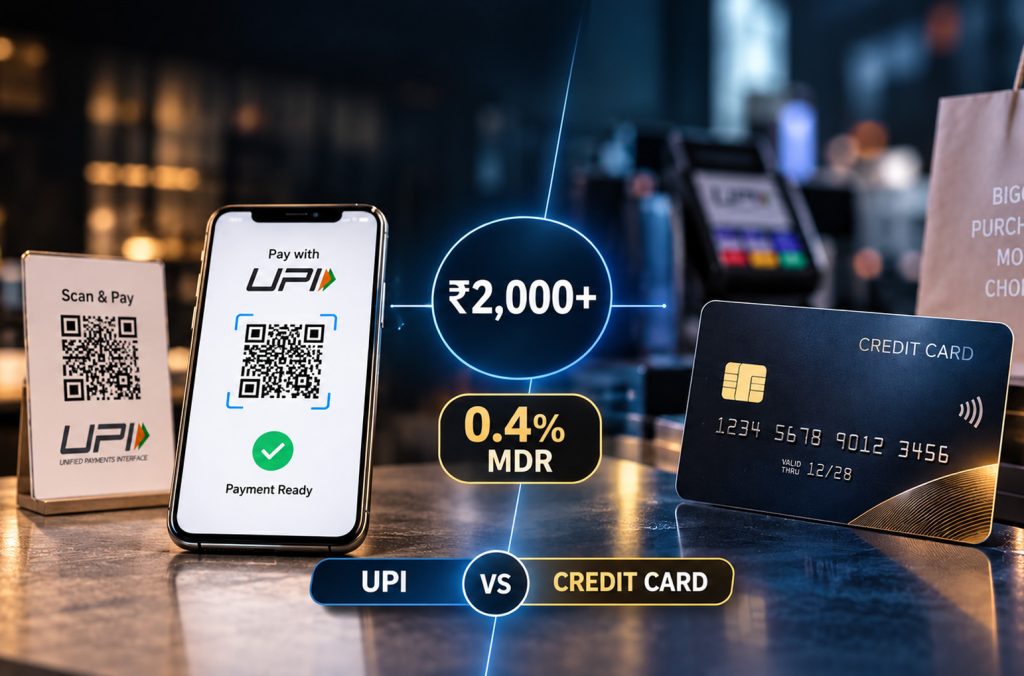
For seven years, scanning a QR code at your neighborhood kirana store, splitting a dinner bill, or paying your electricity vendor has cost exactly nothing. Zero. That is the deal India got used to with UPI, and it fundamentally changed how 1.4 billion people think about digital payments. That deal is about to get its first meaningful asterisk. NPCI has introduced an updated Merchant Discount Rate framework for certain UPI transactions, which shall come into force on October 15, 2026.
The change sounds alarming in the headline. In practice, it is more surgical than sweeping. But it does raise a genuinely interesting question for anyone holding a credit card: does the introduction of UPI merchant charges on larger transactions finally make credit card payments the smarter choice above that threshold? And where does the RuPay credit card sit in all of this, given that it straddles both worlds?
The answer depends on understanding what changed, what didn’t, and how MDR charges work differently across payment instruments. For anyone using a RuPay credit cards linked to UPI for everyday spending, this development has specific implications worth understanding before October 15.
What MDR Actually Is and Why It Disappeared
Merchant Discount Rate is the fee a merchant pays to their bank every time a customer completes a card or digital payment. When you swipe a Visa card at a restaurant, the restaurant pays their acquiring bank a small percentage of the transaction value, split between the acquiring bank, the issuing bank, and the card network.
Effective January 2020, the Central Board of Direct Taxes removed the MDR on person-to-merchant UPI transactions. Making it free for merchants was the accelerant for adoption. It worked spectacularly. UPI processed 24.51 billion transactions worth Rs. 29.82 trillion in August 2026 alone.
The problem is that free for merchants does not mean free to operate. The cost to process a single UPI transaction is as high as 0.25 percent of the transaction value, split across the issuer, UPI app provider, acquirer, and NPCI. All participants incur costs but earn nothing. The government’s incentive scheme funded some of it, but budget allocation reduced year on year: Rs. 2,600 crore in 2022-23 down to Rs. 1,441 crore in 2024-25, even as UPI transaction values swelled. The MDR change is the inevitable consequence of that arithmetic.
What followed the September 14 notification was significant confusion across merchant communities, payment platforms, and consumers who had spent seven years treating UPI as unconditionally free. The government subsequently released a detailed FAQ clarifying which transactions fall under the new framework, which remain protected, and how MDR revenues will be redistributed within the ecosystem. Those UPI MDR FAQs are the clearest single reference available before October 15.
What the New Rules Actually Say
Parliament’s Taxation and Other Laws Amendment Act, 2026, changed the legal framework by removing the blanket zero-MDR requirement and allowing the government to specify which payment categories must remain free.
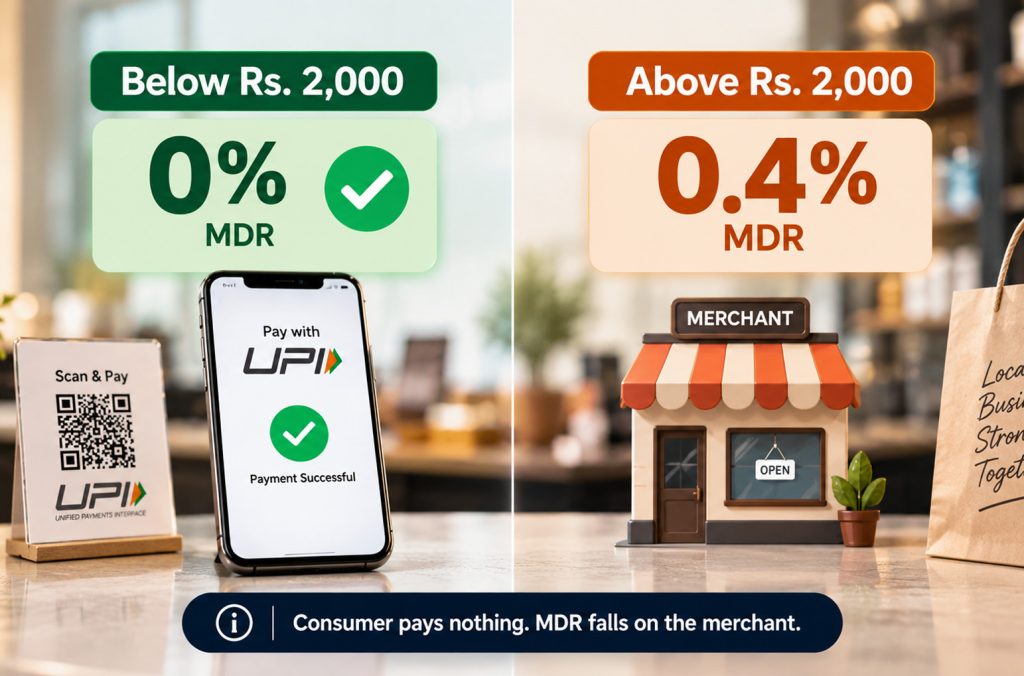
According to the updated framework, P2M UPI transactions above Rs. 2,000 will be subject to 0.4 percent MDR, while for transactions above Rs. 75,000, the MDR will be limited to Rs. 300. The MDR will be paid by merchants. Consumers will not have to pay MDR, while P2P UPI transactions will be exempted.
The government estimates that 96 percent of P2M UPI transactions by volume will be unaffected by the new MDR structure, as transactions up to Rs. 2,000 and qualified P2P transactions will continue to have zero MDR.
Three things that are not changing and are worth stating clearly. You as a consumer pay nothing extra. Person-to-person transfers remain completely free. Transactions below Rs. 2,000 at merchants remain free. The MDR applies to merchants on transactions above Rs. 2,000, not to the sender.
MDR revenues will stay within the UPI ecosystem and contribute to investment in infrastructure, cybersecurity, innovation, resilience, and customer experience.
The RuPay Credit Card: A Different Animal Entirely
The notification separately lists RuPay debit cards as a protected electronic payment mode. RuPay credit cards linked to UPI are different from RuPay debit cards. Merchant charges can already apply to eligible RuPay credit card payments made through UPI, subject to the relevant NPCI framework and exemptions.
This distinction matters enormously. A RuPay credit card used via UPI Scan and Pay was never covered under the zero-MDR protection that standard UPI bank account payments enjoyed. Merchants were already potentially subject to interchange on those transactions. What changes from October 15 is that the gap between a standard UPI payment above Rs. 2,000 and a RuPay credit card UPI payment narrows for merchants.
For cardholders, this is where the strategic question gets interesting. Cards like the HDFC Infinia, Axis Magnus Burgundy, and ICICI Emeralde Private Metal all earn reward points on UPI Scan and Pay transactions made through their RuPay variants. That earning has always been available. The new MDR framework does not change what cardholders earn. It changes what the merchant pays, which in turn may influence whether some merchants start steering customers toward standard UPI bank account payments below the Rs. 2,000 threshold instead.
UPI or Credit Card Above Rs. 2,000: Which Makes More Sense Now?
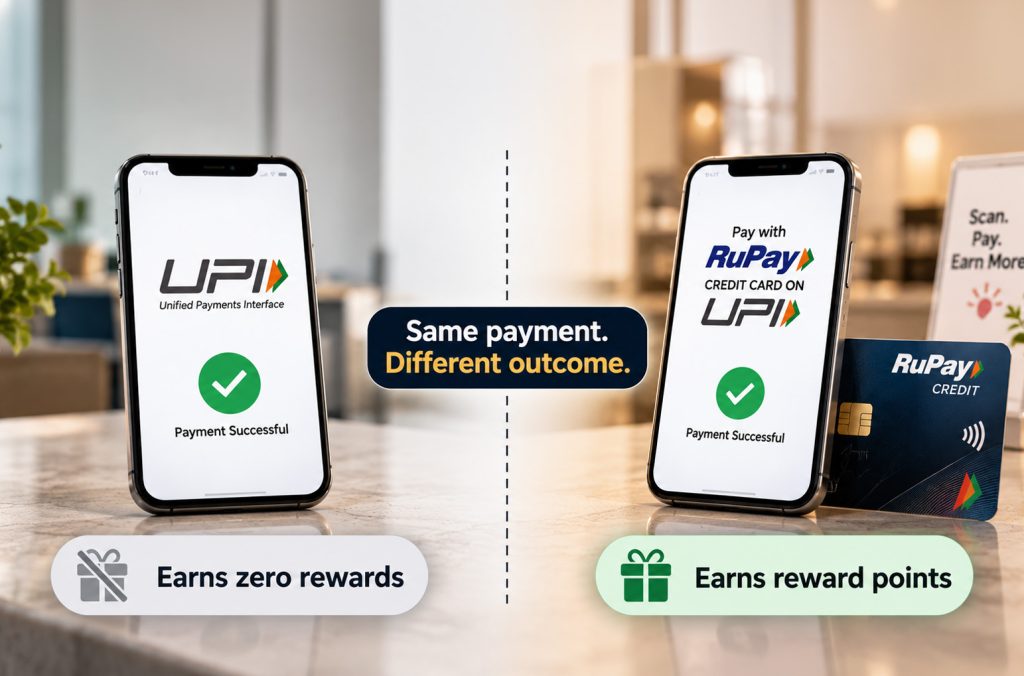
For the consumer, the calculus is straightforward. If you are paying above Rs. 2,000 at a merchant and have a RuPay credit card linked to a UPI app like PhonePe, Google Pay, or CRED, using that card via UPI delivers reward points on the transaction. A standard UPI bank account payment delivers nothing beyond the convenience of a digital transfer.
The merchant’s cost is higher on the credit card transaction, as it always was. But that cost falls on the merchant, not on you. Your decision should be based entirely on what the payment instrument returns to you, not what it costs the merchant.
Here is a practical illustration. A Rs. 8,000 restaurant bill paid via standard UPI above the Rs. 2,000 threshold earns you zero reward points and will cost the merchant 0.4 percent in MDR from October 15. The same Rs. 8,000 bill paid via a RuPay credit card on UPI earns you reward points at your card’s applicable rate and has its own interchange structure that was already in place before this notification. The consumer outcome is clearly better on the credit card, assuming your card earns on dining or general UPI transactions.
The one scenario where standard UPI still makes more sense: when you are close to a monthly reward cap on your card, and additional spend would earn only the base rate anyway. In that case, there is no marginal reward benefit from using the card, and the transaction falls into the same zero-consumer-cost category regardless of the method you use.
What Changes for Merchants and What It Means for You
For consumers and small merchants, the effect is expected to be minimal. Indications suggest an MDR of about 0.4 percent will be charged on transactions above Rs. 2,000, ensuring day-to-day small-ticket payments for groceries, transport, and similar purchases remain unaffected.
The businesses that will feel this most are those with high-value average transaction sizes: electronics retailers, jewelers, premium restaurants, travel agents, and service providers whose typical invoice comfortably exceeds Rs. 2,000. For those merchants, every UPI payment above the threshold now carries a cost that did not exist yesterday.
Some of these merchants may respond by adding a surcharge to UPI payments above Rs. 2,000, which RBI guidelines technically prohibit but which happens in practice. Others may install point-of-sale terminals that give customers the choice between instruments. The NPCI’s official UPI page has the authoritative framework on how these rules apply across merchant categories as the October 15 implementation date approaches.
For credit cardholders, the practical advice is simple. Where you would have previously defaulted to UPI for a large payment out of habit, now consider whether your card’s RuPay variant earns on that transaction. The MDR change has not made credit cards worse. It has made the case for using them on larger transactions marginally stronger, simply by reducing the cost differential that previously made zero-MDR UPI the obvious merchant-friendly choice.
Frequently Asked Questions
No. The merchant pays the MDR, not the consumer. You continue to pay nothing extra on any UPI transaction regardless of the amount.
October 15, 2026, as per NPCI’s updated framework.
No. RuPay credit cards linked to UPI operate under a separate interchange framework that predates this notification. The zero-MDR protection specifically covered standard UPI bank account payments and RuPay debit cards.
If your credit card earns rewards on the transaction category and you have not exhausted your monthly cap, yes. The MDR change does not affect what you earn as a consumer, but it does reduce the cost differential that previously made free UPI the obvious default for large payments.
Unlikely for most merchants, since the 0.4 percent MDR is modest. However, high-value merchants like jewelers and electronics retailers may adjust payment preferences over time as the cost compounds across high-volume transactions.