No one signs a loan form thinking about math. You’re thinking about the flat, the car, the wedding, and the hospital bill. Then the bank comes along and says, “Your EMI will be Rs. 43,391,” and there’s a tiny voice in your head that goes, “Where the hell did that figure come from?”
Good question, and you absolutely deserve a proper answer. Once you understand how an EMI is constructed, you stop just nodding along to the loan officer and start to negotiate. Here’s the straight version, with a calculator doing all the work and a few rupee examples to make it all clear.
What an EMI actually is
EMI stands for equated monthly installment. It’s one fixed amount you pay every month until the loan ends. Each payment has two parts: a slice of interest and a slice of the original loan amount, the principal.
The sneaky part is the split. Early on, most of your money goes to interest. Take a Rs. 50 lakh loan at 8.5 percent over 20 years. In month one, about Rs. 35,400 of your Rs. 43,391 EMI is interest, and only around Rs. 8,000 chips away at the principal. Years later, the proportions flip. That’s why the first few years of a home loan EMI can feel like you’re paying and getting nowhere.
The formula, without the fear
Here it is:
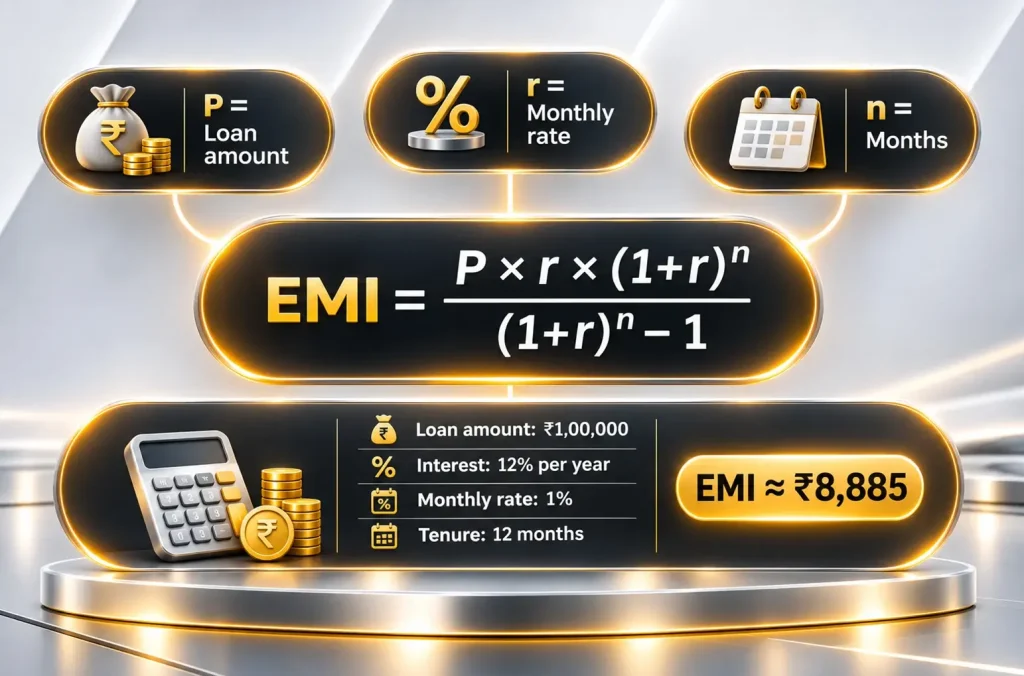
EMI = P × r × (1 + r)^n ÷ ((1 + r)^n − 1)
P is the loan amount. r is the monthly interest rate, which is the yearly rate divided by 12 and then by 100. n is the number of months. Try it on a small loan of Rs. 1 lakh at 12 percent for one year. The monthly rate is 1 percent, n is 12, and the EMI comes to about Rs. 8,885.
Now try doing that for a 240-month home loan on paper. Exactly. That’s why nobody does.
Using a monthly EMI calculator, step by step
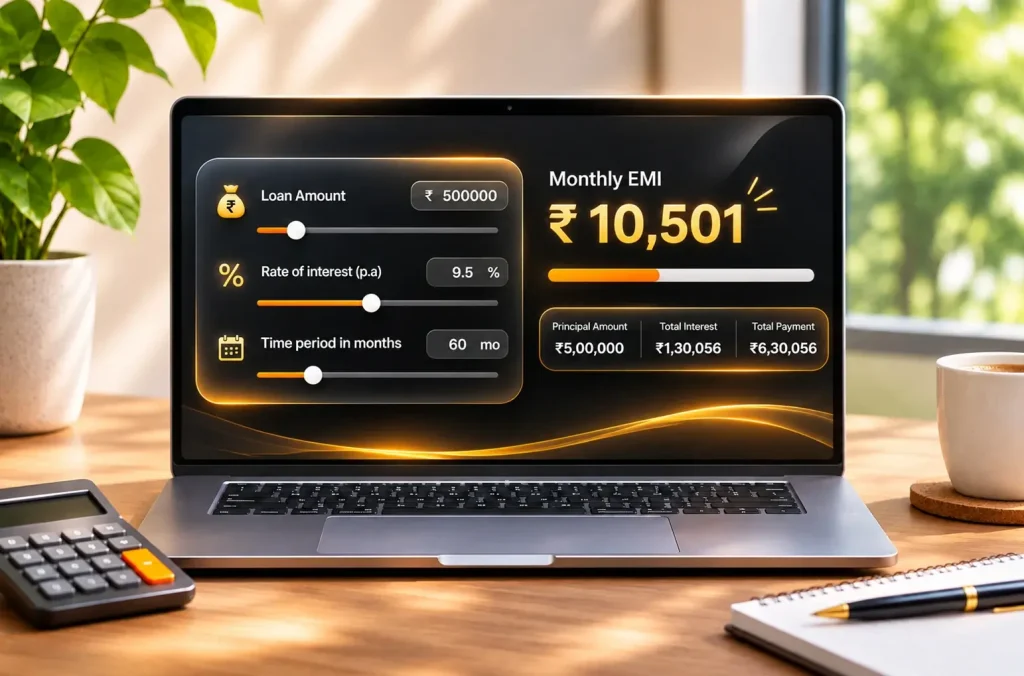
A good calculator turns all that into three boxes. Our monthly EMI calculator works like this:
- Enter the loan amount. Use the amount you’ll actually borrow after your down payment, not the sticker price.
- Enter the interest rate. Use the annual rate your lender quotes, ideally the one in writing.
- Choose the tenure. Months or years, whichever you prefer.
You’ll see the monthly payment, the total interest, and the total you’ll repay. Slide the tenure up and down and watch the EMI and the interest move in opposite directions. Five minutes of that teaches more than any brochure.
If you’d like a second opinion, then most lenders will have their own tools, and a bank EMI calculator will show you how that lender’s numbers stack up against the general rule of thumb.
Home Loan EMI, Personal Loan EMI, and Car Loan EMI: three examples
The rates below are just illustrative, not actual current offers, so please swap them in for your own.
| Loan | Amount | Rate | Tenure | EMI | Total interest |
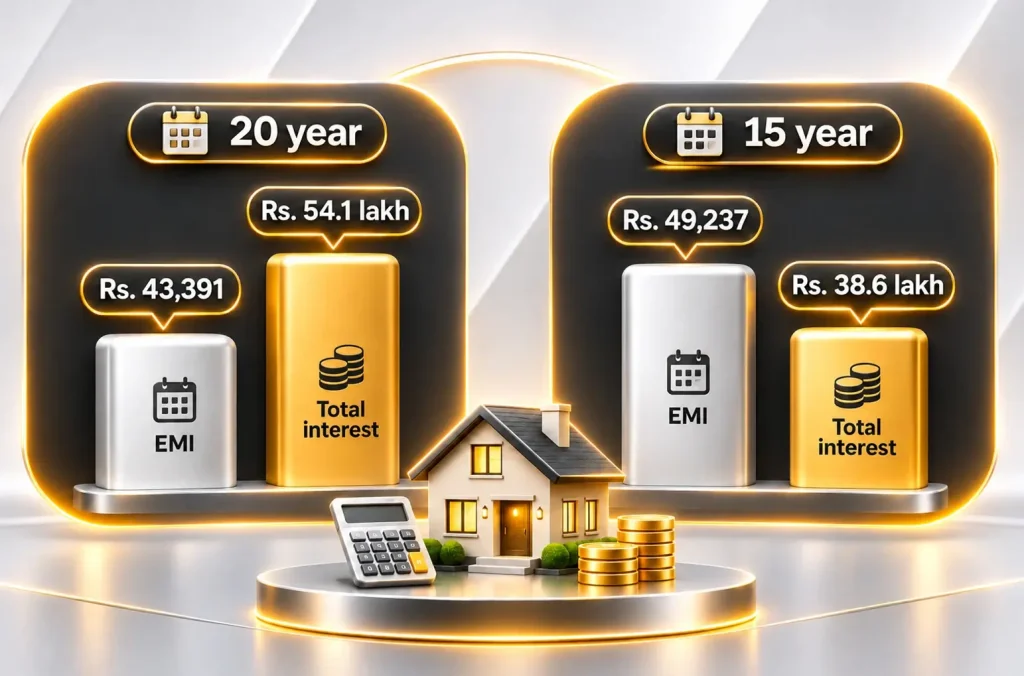
| Home loan | Rs. 50,00,000 | 8.50% | 20 years | Rs. 43,391 | About Rs. 54.1 lakh |
| Home loan | Rs. 50,00,000 | 8.50% | 15 years | Rs. 49,237 | About Rs. 38.6 lakh |
| Personal loan | Rs. 5,00,000 | 12% | 3 years | Rs. 16,607 | About Rs. 97,900 |
| Personal loan | Rs. 5,00,000 | 12% | 5 years | Rs. 11,122 | About Rs. 1.67 lakh |
| Car loan | Rs. 8,00,000 | 9% | 5 years | Rs. 16,607 | About Rs. 1.96 lakh |
| Car loan | Rs. 8,00,000 | 9% | 7 years | Rs. 12,871 | About Rs. 2.81 lakh |
Look at the first two rows. If you cut your home loan EMI tenure from 20 to 15 years, your EMI goes up by approximately Rs. 5,800 a month, and you save around Rs. 15.5 lakh on interest. That’s the price of a flat’s worth of furniture.
A personal loan EMI behaves the same way, only faster, because rates are higher and tenures shorter. Stretching Rs. 5 lakh from three to five years drops the EMI by around Rs. 5,500 but costs you an extra Rs. 69,000 or so in interest. And a car loan EMI is the one people stretch without thinking, because seven years sounds like a small monthly number. It adds about Rs. 85,000 in interest compared with five.
How to bring your EMI down without paying for it later
A low EMI is easy to achieve. A cheaper loan is harder to get. Go for the second.
- Borrow less. A larger down payment will reduce both your EMI and the interest you pay.
- Compare rates before you fall in love with a property or a car. A half of a percentage point can make all the difference over 20 years.
- Read the full cost. The RBI mandate is that lenders provide a Key Facts Statement with all new retail loans, which will show the APR (Annual Percentage Rate) which will include all the charges beyond the interest rate. Ask for it.
- Prepay whenever you can. Paying a lump sum early in the loan will attack the interest-heavy years. Always check your agreement first to see what the prepayment terms are.
Don’t forget the loan you didn’t plan
Credit card purchases can be converted into EMIs too, and the fees and rates there deserve the same calculator treatment. If you shop on EMI often, a good card helps: browse our shopping credit cards and cashback credit cards to see which suit your spending, or use the credit card finder to match your profile. Remember that EMI conversions often earn no reward points, so our reward calculator helps you see what you’re giving up.
Before you sign
Run your monthly EMI calculator three ways: on the tenure you want, on a shorter tenure and on a longer tenure. Keep your total EMIs (across all your loans) at about 40% of your monthly income or below if you can. That’s a rule of thumb that you’ll often see among lenders, not a rule in any formal sense, but it will prevent a bad month from turning into a bad year.
Frequently Asked Questions
Using the formula P × r × (1 + r)^n ÷ ((1 + r)^n − 1), where P is the principal, r is the monthly rate and n the number of months. A calculator does it in seconds.
Per rupee borrowed, usually yes. Personal loans have higher rates and shorter tenures, so the monthly outgo and the interest cost are much steeper.
The loan amount, the interest rate, and the tenure. A larger down payment and a shorter tenure will have the biggest impact on the total cost.
It’s accurate on the numbers you put in. Your actual EMI could be different if the lender is going to add on processing fees, insurance, and/or a variable rate.
Yes. The EMI calculator that the bank provides will use the rate that you input. The final offer will be subject to your credit profile and the charges as detailed in your sanction letter.