
Two credit cards. Both run on RuPay. Both link to UPI. Both promise to reward you for the way you already spend. On paper, the Tata Neu Infinity Credit Card and the Google Pay Flex Credit Card are chasing the same person: the urban Indian who pays for everything with a phone scan and wants something back for it.
In practice, they are built around completely different philosophies, reward different behaviors, and will deliver very different returns depending on where your money actually goes every month. One is an ecosystem play that rewards loyalty to a single conglomerate. The other is a UPI-first card designed to reward you on the platform you are probably already using every day without thinking about it.
Before getting into the numbers, both these cards sit within issuer portfolios that go well beyond these two products. The HDFC card lineup and the Axis Bank card range each offer progressively stronger products for higher spenders, which helps if either card leaves you wanting more.
The Cards at a Glance
| Feature | Tata Neu Infinity HDFC | Google Pay Flex Axis Bank |
| Annual fee | Rs. 1,499 + GST | Lifetime free |
| Fee waiver | Spend Rs. 3 lakh annually | No waiver needed |
| Top reward rate | Up to 10% NeuCoins on Tata Neu | Up to 8 Stars per Rs. 500 (above Rs. 30,000 spend) |
| Base reward rate | 1.5% NeuCoins on other spends | 2 Stars per Rs. 500 (0.4%) |
| UPI reward rate | Up to 1.5% NeuCoins (capped at 500/month) | Stars on all UPI spends, redeemable instantly |
| Reward currency | NeuCoins (1 NeuCoin = Re. 1 within Tata ecosystem) | Stars (1 Star = Re. 1 on Google Pay UPI) |
| Card network | RuPay and Visa | RuPay |
| Lounge access | Yes, milestone-based (Rs. 50,000 quarterly spend) | No |
| Welcome benefit | 1,499 NeuCoins on activation | Rs. 250 gift card + 250 bonus Stars |
Tata Neu Infinity Credit Card: The Ecosystem Loyalist’s Best Friend
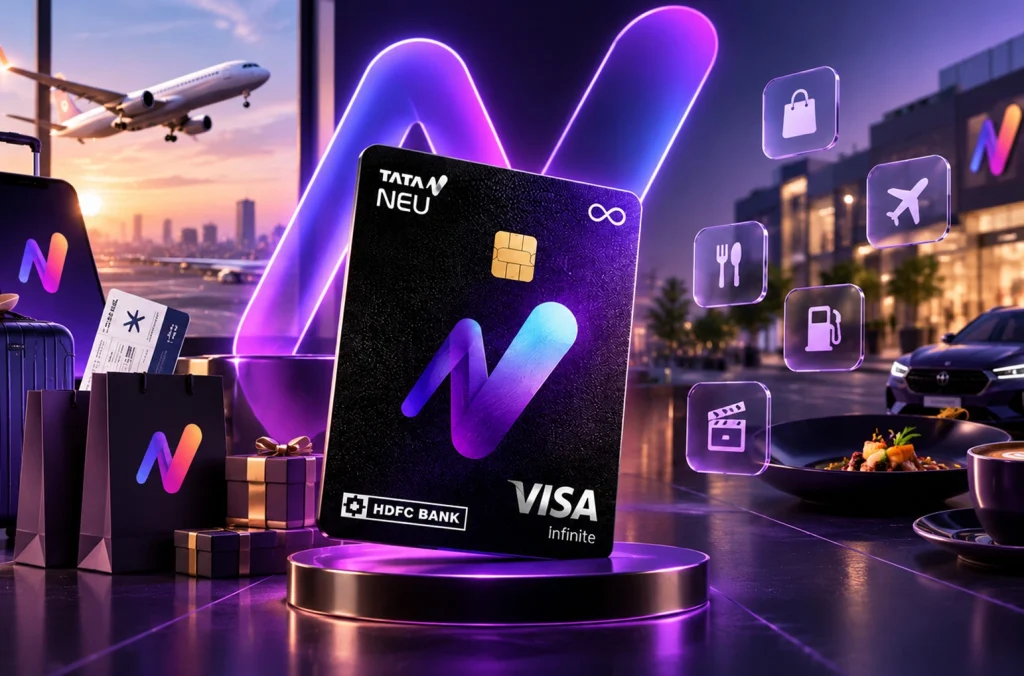
The Tata Neu Infinity Credit Card is built around a simple proposition: if you spend within the Tata ecosystem, you earn at a rate that few cards at this fee level can match.
Up to 10 percent NeuCoins on select Tata Neu purchases means that BigBasket grocery orders, Air India flights booked through Tata Neu, Westside clothing, and Tata Play subscriptions all earn at a rate that comfortably beats most cashback cards. The 5 percent base rate on all Tata Neu non-EMI transactions is the floor, with an additional 5 percent available on select categories when you use the Tata Neu app and register for NeuPass.
Outside the Tata ecosystem, the card earns 1.5 percent NeuCoins on all other spending. Respectable but not spectacular, and firmly in the same territory as cards costing half the annual fee.
UPI earnings are where this comparison gets interesting. The RuPay variant earns 0.5 percent NeuCoins on eligible UPI transactions through any UPI app, with an additional 1 percent if you use the Tata Neu UPI ID specifically. Total UPI earnings are capped at 500 NeuCoins per calendar month, which is roughly Rs. 33,000 in UPI spend before the cap kicks in. HDFC Bank’s official Tata Neu Infinity has the full current benefit structure, and it’s worth reading to understand the card’s rewards and eligibility before applying.
Lounge access, fuel surcharge waivers, and premium travel perks give this card a lifestyle dimension that Google Pay Flex simply doesn’t offer. Two domestic lounge visits per quarter unlock when you spend Rs. 50,000 in that quarter. You get four international visits via Priority Pass annually. For someone who travels a few times a year and shops heavily within the Tata universe, this card earns its annual fee without much effort.
The critical limitation: NeuCoins are redeemable only within the Tata ecosystem. You cannot convert them to statement credit, transfer them to airline partners, or use them at non-Tata merchants. If your shopping habits shift away from Tata brands, the accumulated balance has nowhere useful to go.
Google Pay Flex Credit Card: The UPI Maximizer

The Google Pay Flex Credit Card exists in two versions. The Axis Bank variant is lifetime free with a stars-based reward structure. The SBI Card variant, launched July 29, 2026, carries a Rs. 499 annual fee waived at Rs. 1 lakh in annual spend, with welcome benefits worth Rs. 1,000 and up to Rs. 18,000 in annual rewards value.
Both versions share the core mechanic: earn Stars by spending, then redeem Stars directly on UPI payments through Google Pay at a 1:1 ratio (1 Star = Re. 1). You accumulate Stars, and they reduce your next UPI payment directly within the app.
The Google Pay Flex Axis Credit Card starts at 2 Stars per Rs. 500 spent, scaling to 4 Stars at Rs. 15,000 monthly spend and 8 Stars at Rs. 30,000 monthly spend. At 8 stars per Rs. 500, the effective return is 1.6 percent. That is the maximum rate, achieved only when you consistently cross Rs. 30,000 in monthly spend. For someone spending below that threshold, the return is more modest.
The Google Pay Flex SBI Credit Card offers a similar tiered structure with up to 8 stars per Rs. 500, a 15 percent dining discount on EazyDiner capped at Rs. 500 per month, and the flexibility of both RuPay and Visa variants. The RuPay version enables UPI credit card payments at millions of merchants, which is the card’s primary design purpose. For anyone building their understanding of how the UPI credit card ecosystem works in India, Google’s overview of the Flex card clearly explains the philosophy behind it.
The lifetime-free Axis variant’s weakness is its base earning rate. At 2 stars per Rs. 500 before any milestone kicks in, you are earning 0.4 percent on general spend. That is thin. The card only becomes genuinely rewarding once you consistently exceed the Rs. 15,000 monthly spend milestone and is competitive above Rs. 30,000. Below those thresholds, the zero annual fee is the card’s strongest feature, not the rewards.

The UPI Rewards Head-to-Head
Both cards earn on UPI transactions via their RuPay variants, the key feature that distinguishes them from standard credit cards. But the mechanics are meaningfully different.
The Tata Neu Infinity earns up to 1.5 percent NeuCoins on UPI, capped at 500 NeuCoins per month. The cap limits the total monthly UPI reward to Rs. 500 in NeuCoin value, regardless of how much UPI spend you make above Rs. 33,000. The reward is useful but limited, and it stays locked within the Tata ecosystem when redeemed.
The Google Pay Flex earns stars on all UPI transactions with no separately stated UPI-specific cap, redeemable instantly against any UPI payment on Google Pay. The simplicity of instant redemption on any merchant is a genuine differentiator. You don’t wait for a statement cycle, navigate a rewards portal, or wonder whether the merchant accepts NeuCoins.
For someone whose primary UPI usage spans multiple merchant categories and platforms, Google Pay Flex’s instant, flexible Star redemption wins on usability, even if Tata Neu Infinity’s 1.5 percent UPI rate is slightly higher before the cap.
Which One Should You Actually Get
Choose the HDFC Tata Neu Infinity Credit Card if you regularly shop on BigBasket, book flights on Air India, use Tata Play, or spend meaningfully at Westside and other Tata brands. At Rs. 3 lakh annual spend, the fee disappears, and the 10 percent NeuCoin rate on select Tata categories is among the best ecosystem-specific returns available in India. Lounge access and travel perks add value the Flex cannot match. Before applying, run your typical monthly Tata brand spend through the HDFC SmartBuy savings calculator to see what your NeuCoin return looks like annually, because the difference between hitting and missing the Rs. 3 lakh fee waiver threshold can meaningfully change the card’s net value for your spending pattern.
Choose the Google Pay Flex Credit Card if you want a zero-fee entry into UPI credit card rewards with no ecosystem lock-in. The instant Star redemption on any Google Pay UPI transaction is genuinely frictionless, and the lifetime free structure means every rupee of reward is pure net gain. It works best for consistent spenders above Rs. 15,000 per month, where the milestone multipliers kick in. Here is what Axis Bank, as an issuer, provides if you want to understand where Flex sits within Axis’s broader portfolio.
Hold both if your spending spans the Tata ecosystem and everyday UPI transactions across other merchants. The Tata Neu Infinity handles Tata brand spending at 10 percent, while the Google Pay Flex handles everything else on UPI at zero annual cost. That combination costs Rs. 1,499 per year before the waiver and covers two very different earning categories without overlap.
Frequently Asked Questions
For the raw UPI reward rate, Tata Neu Infinity at up to 1.5 percent edges out Google Pay Flex before the cap. For flexibility and instant redemption with no ecosystem lock-in, Google Pay Flex wins on usability.
The Axis Bank variant is lifetime free, with no annual fee. The SBI Card variant carries Rs. 499 per year, waived at Rs. 1 lakh annual spend.
Yes. Both the Tata Neu Infinity and Google Pay Flex are available on RuPay, so you can link both to UPI apps for Scan and Pay transactions at any UPI-accepting merchant.
One NeuCoin equals Re. 1 but is redeemable only within the Tata ecosystem, including BigBasket, Air India, Westside, Tata Play, and other Tata brands. You can’t use them outside the Tata universe.
Google Pay Flex, without question. The Tata Neu Infinity’s best earning rates are entirely dependent on Tata brand spending. Outside that ecosystem, it earns 1.5 percent, the same as several cheaper or free alternatives.