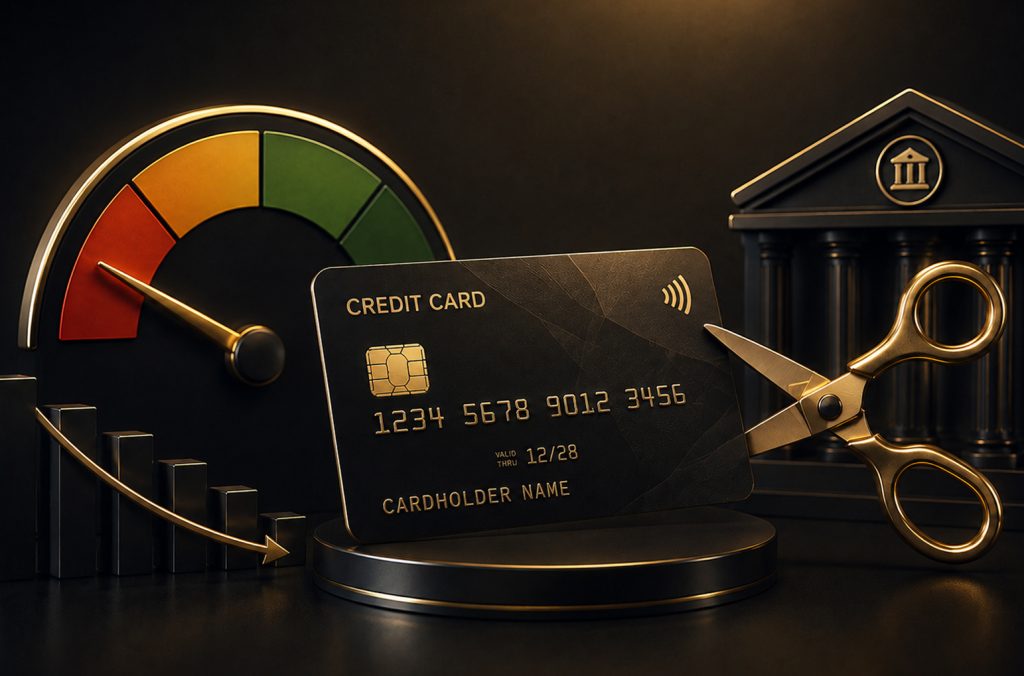
There’s a card sitting in most people’s wallets right now that hasn’t been touched in six months. The annual fee just renewed. The rewards aren’t going anywhere. And the same question keeps circling back: why not just close it?
It’s a fair question. But whether closing a credit card hurts your credit score is one of those decisions that feels a lot smaller than it actually is. Your CIBIL score can shift in ways you didn’t plan for, sometimes weeks after the fact, and how much it matters depends heavily on what else is going on with your finances at the time. None of this means you should never close a card, by the way. It just means going in with your eyes open. And if the card in question is one you’re only holding onto for its rewards, it’s worth checking how it stacks up against CCB’s Top Credit Cards pick before deciding it’s not worth keeping.
The Three Things That Actually Move Your Credit Score
A CIBIL score isn’t a fixed number sitting quietly on a server somewhere. It recalculates every time your lenders send new information to the bureau. Closing a card sends exactly that kind of signal, and it moves your CIBIL score in three distinct ways.
Your credit utilization climbs, often immediately:
This is the one people don’t see coming until it’s already happened. Utilization is simply the percentage of your total available credit that you’re currently using. Say you’re holding three cards with a combined limit of ₹3 lakh, and your outstanding balance across all of them is ₹60,000. That’s 20% utilization, comfortably healthy. Close one card with a ₹1 lakh limit, and your available credit drops to ₹2 lakh while your outstanding stays exactly where it was. Your utilization just jumped to 30%, and depending on where that lands relative to the bureau’s risk thresholds, your score can drop by 20 to 50 points or more. Most Indian bureaus want you under 30%. Losing a big chunk of your available limit can push you over that line without you spending a single extra rupee.
Your average account age shrinks:
Every account on your report has an age, and bureaus average that age across everything you hold. Close one of your older cards, and that average drops, pulling your score down with it. There’s a small silver lining here: a closed account in good standing doesn’t vanish overnight. It typically stays on your report for up to seven years, still carrying some historical weight. But going forward, the hit to your average age is real, and it takes time to rebuild.
Your credit mix narrows slightly:
Bureaus like seeing that you can manage different kinds of credit: cards, personal loans, home loans, and so on. Closing a card doesn’t wreck this on its own, but it does trim the breadth of your profile a little. It’s the smallest of the three factors, but it still adds to the total.
When Closing the Card Is Actually the Smart Move
The impact on the score is real, but it’s not the only thing that matters here. Sometimes keeping a card open costs you more than the temporary dip is worth.
An annual fee you’re not recovering in value is a straightforward yearly loss. A card that keeps tempting you to overspend is a bigger risk to your finances than a few lost points. And a card with a reward structure so complicated you’ve stopped bothering to use it properly is really just clutter with a price tag on it.
The honest way to think about it: what is this card costing you every year, and what is it actually giving back in rewards, benefits, or credit-profile value? If the cost keeps winning that comparison, closing it is the financially sound call. The score dip fades. The fee you’re paying for a card you don’t use doesn’t.
Closing a Card Without Making It Worse Than It Needs to Be
Here’s something that gets missed a lot: most of the credit score damage people blame on “closing a card” is actually caused by how they closed it, not the closure itself.
Clear your outstanding balance in full before you request closure. A card carrying any remaining balance can’t be closed cleanly, and interest keeps accruing on it even after you’ve submitted the request.
Redeem every reward point first. Once the account shuts down, unredeemed points are gone for good: no exceptions, no recourse. If you’ve been quietly stacking up points on one of the better cards in your wallet, that balance might be worth more than you’d guess. Worth running it through CCB’s Rewards Calculator before you make the call, just so you know exactly what you’d be walking away from.
Cancel every standing instruction and auto-debit tied to that card. Streaming subscriptions, insurance premiums, utility bills-anything that tries to charge after closure will simply fail, and a failed payment can land on your credit report as a delinquency.
Call your issuer and request a formal closure. Don’t just stop using the card or cut it up and hope for the best. An account that isn’t formally closed stays alive on your report and can keep generating annual fees. Get written confirmation and follow up in 30 to 45 days to ensure the closure was correctly reported to the bureau.
One more habit worth building in here: you can pull a free credit score check through CIBIL’s official website once a year, no cost involved. Doing that before and after a decision like this catches errors before they turn into real problems.
The One Scenario Where You Should Just Wait
If a home loan, car loan, or any major credit application is on your radar in the next three to six months, don’t close a card in that window. Even a temporary 20 to 30 point dip can affect the interest rate you’re offered or the limit you get approved for on something new. Let the loan process and disbursement take place first, then come back to the closure decision once the pressure’s off.
Timing, more than anything else here, is usually what separates a closure that barely registers from one that quietly costs you a better rate.
What Actually Happens After You Close It
Recovery time depends a lot on what the rest of your profile looks like. If your other cards are in good standing, your utilization on them is low, and your payment history is clean, most people see their score stabilize within two to four billing cycles. The full effect rarely lingers past six months if the rest of your accounts are being managed well.
The long game here is more forgiving than most people assume. A closed account in good standing remains on your report for up to 7 years, still contributing some historical weight. It doesn’t vanish the day it closes. It just stops generating new activity, and its influence on your score fades gradually rather than all at once.
After that, it’s mostly about consistency: keep utilization low on whatever cards you still hold, pay every statement in full, and hold off on a flurry of new credit applications in the same window. The score finds its way back. It just needs a bit of time and steady habits to get there.
Frequently Asked Questions
Not always. If it’s not costing you an annual fee, leaving it open usually helps more than closing it.
No, not even close. A missed payment does far more damage and stays on your report longer.
Not instantly. It usually shows up on your report within a billing cycle or two after the closure is processed.
Generally no. Closing your oldest account shrinks your average account age the most, so it’s