
Here is a question that comes up in every credit card conversation eventually. Is it better to put everything on one strong cashback credit card and keep life simple, or split spending across multiple cards to extract the highest possible return from each category? Both camps have passionate defenders, and both have people quietly leaving money on the table.
The honest answer is that neither approach is universally correct. The right cashback strategy depends on how much you spend monthly, how many categories your spending spans, and how much mental bandwidth you are willing to put into managing more than one card. What follows is the framework that actually resolves the debate rather than just restating it.
India’s best cashback credit cards and their category-specific returns are all in the cashback credit cards section, and the rewards calculator will show you in rupees what each calculation returns on your actual monthly numbers before you commit to either approach.
The Case for One Card: Simplicity That Actually Pays
People who’ve spent years optimizing their wallets tend to wave off the one-card approach, and I think that’s a mistake. For many people, it’s the smart move, no apology needed.
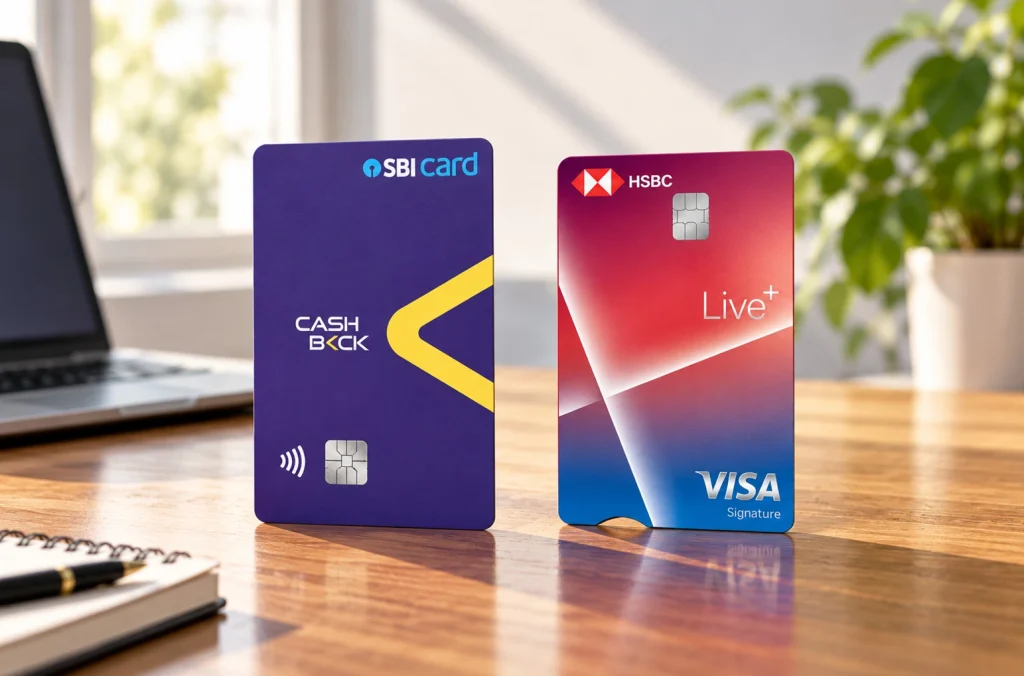
Take the SBI Cashback Credit Card. It gives you 5% on eligible online spends, whichever site you’re on- so Myntra, Nykaa, Amazon, Tata Cliq, your food delivery app- all of it earns the same rate and you never have to stop and think. Or the HSBC Live+ Credit Card, which pays 10% on groceries, dining, food delivery, shopping and utilities, up to ₹1,200 a month. If that’s where most of your money goes anyway, and it rarely tops ₹12,000, this one card does nearly all the work.
So who should stick to one? Mostly people who spend under ₹30,000 a month, keep it to two or three categories, and would rather open one bill on one date than juggle a few. If paying two annual fees makes you wince, that’s another good sign. People who won’t be happy with it are those whose spending is scattered across four or more categories, since no single card pays above 2% on all of them.
The Case for Multiple Cards: Where the Real Money Sits
The multiple-cards debate always makes the extra effort sound bigger than it is. Honestly, it’s about thirty seconds of thinking, and you only do it once. Decide that Amazon Pay ICICI handles Amazon and HSBC Live+ handles your everyday offline spending, and after that it becomes muscle memory.
Here’s how that plays out on ₹50,000 a month. The SBI Cashback Card alone, at 5% online and 1% offline, brings back roughly ₹2,500 to ₹3,000 a month, so ₹30,000 to ₹36,000 over a year. Now add Amazon Pay ICICI for Amazon, HSBC Live+ for groceries, dining and utilities, and let SBI keep the rest of your online spend. Same spending, but you’re looking at about ₹42,000 to ₹52,000 a year, mostly thanks to that 10% rate landing on things you buy every week anyway.
That ₹10,000 to ₹16,000 gap is what the whole debate comes down to, and you don’t need a spreadsheet obsession to collect it. If you’re curious what it looks like for you, pop your own monthly spend into the reward points calculator. Generic examples only take you so far, and your numbers will tell you more.
The Three-Card Wallet: Maximum Return, Manageable Complexity
The Setup Most Consistent Earners Actually Use
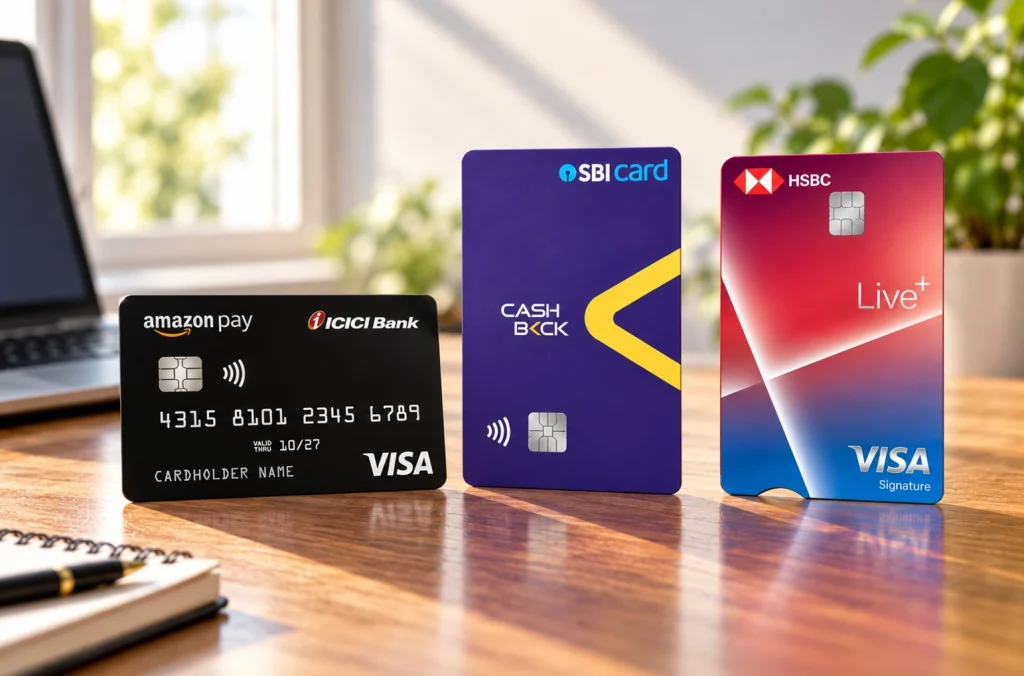
The sweet spot for most urban Indian households is a three-card wallet, each card handling a distinct spending lane with minimal overlap.
Card 1: The free base layer. The Amazon Pay ICICI Credit Card, lifetime free, earns 5% on Amazon for Prime members with no annual cost. Every rupee of cashback it earns is pure net gain. This card handles all Amazon purchases, including Fresh, Pantry, and Now.
Card 2: The everyday cashback engine. The HSBC Live+ Credit Card earns 10 percent on groceries, dining, food delivery, shopping, and utilities, capped at Rs. 1,200 per month. This card covers daily life: the kirana run on Blinkit, the Swiggy order, the electricity bill, the weekend brunch. At Rs. 12,000 in monthly spend across these categories, the cap is hit, and the card automatically returns Rs. 1,200 in statement credit.
Card 3: The broad online sweep. The SBI Cashback Credit Card earns 5% on all other eligible online transactions, up to a Rs. 5,000 monthly cap. This card catches everything the first two miss: travel bookings, fashion platforms, electronics, OTT subscriptions, and any other online merchant not covered by the specific category cards above.
Annual fee across this three-card setup: Rs. 999 for the SBI Cashback Card, with the HSBC Live+ waived at Rs. 2 lakh annual spend and the Amazon Pay ICICI permanently free. Effective annual cost in most spending profiles: Rs. 999 or less.
The Pitfalls That Kill Cashback Strategies
Most cashback strategies don’t fail because of the wrong card. They fail because you forgot to use the right one.
It happens in small moments. You grab the wrong card at checkout, default to UPI when a card would have paid you back, or put a big purchase on a card that earns a third of what another one would have. Add that up over a year, and the return you planned drifts far from the return you actually got.
The other quiet culprit is the monthly cap. HSBC Live+ stops at ₹1,200 a month, SBI Cashback has its own ceiling, and Amazon Pay ICICI has no stated cap. Say you put ₹20,000 on Swiggy and Blinkit in a month and hit the Live+ cap on the 12th. The remaining ₹8,000 in that category earns 1.5% instead of 10%, and you’d likely never notice.
You don’t need a spreadsheet to catch this. Once a month, check your card’s reward accrual against your statement and make sure it matches what you expected. Most banking apps show it in real time. CCB’s cashback credit cards comparison lists current caps, so you know where the ceiling sits before you hit it. If you’re still choosing your next card, here’s how to apply for a credit card in 2026.
The Credit Score Question: Does Holding Multiple Cards Actually Hurt You?
One of the most persistent myths in the multiple credit cards pros and cons debate is that more cards damage your CIBIL score. The reality is more nuanced.
Applying for several cards in a short period creates hard inquiries, which can temporarily dip your score. But keeping multiple active cards with low utilization and a clean payment history can improve it over time. Your utilization is calculated across all your limits combined, so more cards with unused limits lower that percentage, which bureaus read as a positive signal.
What matters isn’t how many cards you hold. It’s whether you pay every statement in full and keep combined utilization under 30 percent. Get those two right, and the card count barely matters.
The Simple Decision Framework
Stick to one card if you spend under ₹25,000 a month, mostly online, across two or three categories that a single strong card already covers well. The SBI Cashback Card works for broad online spending, and the HSBC Live+ suits everyday categories. Both are among the best credit cards in India right now.
Go for two or three cards if you spend ₹30,000 or more across varied categories, have Prime, and don’t mind a few seconds of thinking before each purchase. Amazon Pay ICICI, HSBC Live+, and SBI Cashback together cover almost every scenario at a strong rate.
Skip the fourth card unless it fills a real gap, has a fee you can easily recover, and you’ll actually remember to use it.
Cashback doesn’t care which approach you prefer. It rewards whoever uses the right card at the right moment, and the rewards calculator turns that choice into a number instead of a guess.
Frequently Asked Questions
Depends on how much you spend. If it’s above ₹30,000 a month across different categories, multiple cards usually earn more. If you spend less and it’s concentrated in two or three categories, one strong card does the job.
Not on its own. Applying for several cards in a short window can cause a small, temporary CIBIL score dip. But multiple cards with on-time payments and low combined utilization usually help your score over time.
Amazon Pay ICICI for Amazon purchases (5% with no annual fee), plus HSBC Live+ for groceries, dining, food delivery, and utilities at 10%. Between them, they cover the two categories most people spend on most often.
Most banking apps update in real time; check the rewards section after a large purchase. When reaching the cap, use another card in that category, and you won’t earn at the lower base rate.
Yes. you can calculate how much you spend each month on each category and compare with a two-or three-card scenario on the same figures. The annual savings in rupees will show you which option is better for you.