
There is a very specific feeling that comes with getting a new credit card. You open the app, see the welcome bonus land, earn accelerated points on your first few transactions, and briefly feel like you have cracked the system. Six months later, the points are piling up but the excitement is not. The cashback feels smaller. The rewards feel harder to use. The card that felt like a cheat code now feels like just another thing in your wallet.
This is not your imagination. It is not even the card’s fault, at least not entirely. There is a predictable pattern behind why credit card rewards stop feeling rewarding, and understanding it is the difference between a card that compounds in value over time and one that quietly costs you more than it returns. Running your own numbers through CCB’s reward points calculator is usually the fastest way to see which side of that line your card actually falls on.
The Welcome Bonus Was Never Meant to Last
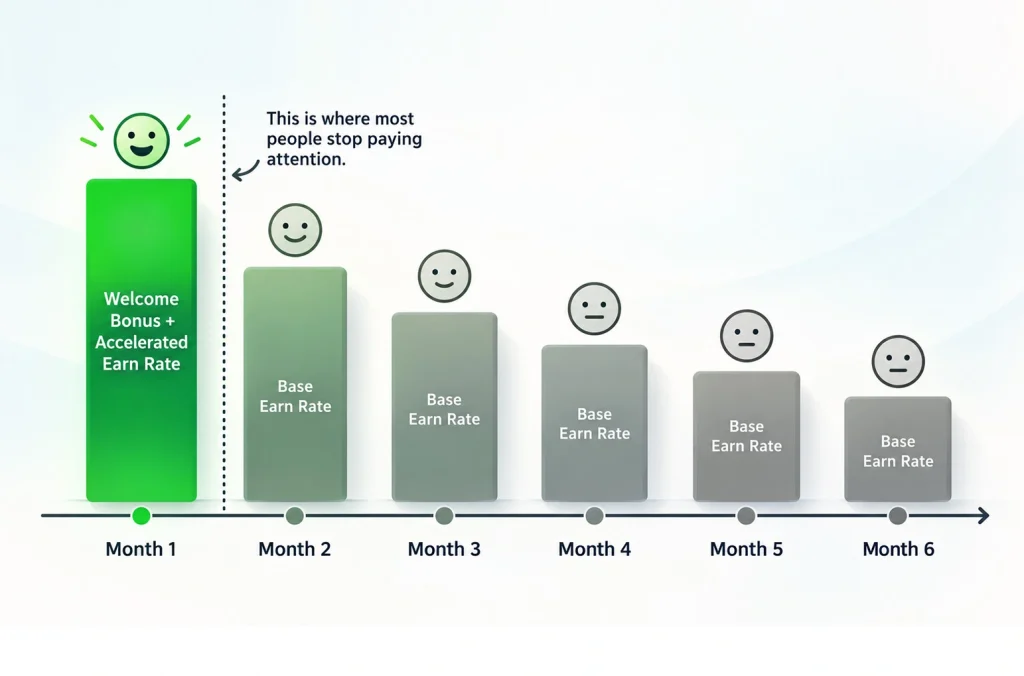
The first thing to understand is that the emotion you felt in month one was manufactured. Welcome bonuses, accelerated first-spend rewards, and joining benefit credits are deliberately structured to make the card feel exceptional at the start. Banks know that the decision to keep or cancel a card is made in the first three to six months. Everything in the onboarding experience is designed to get you past that window.
The RBI’s own guidelines on credit card transparency require banks to disclose all charges and terms upfront, but there is no requirement to disclose that the emotional high of a welcome bonus is a deliberate retention mechanism. Once that initial credit lands and you have spent through the elevated welcome-period earn rate, the card reverts to its base structure and the comparison becomes much more honest.
What most people do not realise is that the welcome bonus is often the single largest reward event on the card’s entire annual calendar. Everything after it is incremental accumulation at the base rate, and incremental accumulation is far less satisfying to watch than a one-time credit landing in your account.
Your Reward Points Are Piling Up But Going Nowhere
The second reason credit cards stop feeling rewarding is simpler and more frustrating. Points accumulate. Redemption never happens. A rewards balance that sits at 8,000 points, 12,000 points, 22,000 points feels like wealth on paper and delivers nothing in practice.
This is partly a design feature, not a bug. Banks assign a parameter called leakage in their financial models: the percentage of points that expire unused or get redeemed at low value. Points that expire are pure profit for the issuer. Points redeemed for a product catalogue at Rs. 0.20 per point are nearly as good. The system is not set up to remind you when your points are close to their best redemption window. It is set up to make accumulation feel like progress even when the balance is doing nothing for you.
The antidote is treating credit card rewards as a currency with an expiry, not a savings account. Most Indian banks set point expiry at two to three years, which sounds generous until you realise that two years of ignoring a balance is exactly how most people end up redeeming at the worst possible value right before expiry.
The Monthly Cap Your Card Never Reminded You About
Ask most cardholders what their card’s monthly reward cap is and you will get a blank look. Yet that cap is the single most important number determining what the card actually returns to them every month.
The HDFC Millennia caps accelerated cashback at 1,000 CashPoints per month. The HSBC Live+ caps 10 percent cashback at Rs. 1,200 per month. The Axis ACE caps 5 percent Google Pay cashback. These caps exist on virtually every best cashback credit card in India and they are the reason why the card’s headline rate rarely translates to the return most cardholders expect.
Here is what typically happens. In month one, you are paying attention. You route spending carefully, hit the right merchants, and earn close to the cap. By month four, you have stopped paying attention. You swipe the card everywhere, hit the cap on day 12 of the billing cycle, and spend the remaining 18 days of the month earning base rate on every transaction while assuming you are still earning at the headline rate.
The card did not change. Your attention did. And the return quietly dropped without anyone sending you a notification.
Your Credit Card Offers Changed While You Were Not Looking
India’s credit card benefits landscape in 2026 has seen more mid-year programme changes than any previous year. Axis Magnus cut its effective return significantly. A new voucher sub-cap introduced in July has quietly changed how much HDFC SmartBuy redemptions are actually worth, worth running through CCB’s SmartBuy savings calculator before assuming your usual redemption still pays out the same. Amex discontinued the Reward Multiplier in September. SBI restructured milestone thresholds on multiple cards.
None of these changes required your consent. Most arrived via email notifications that are easy to miss and even easier to file away without reading. The card you optimized your spending around in January may have delivered significantly lower returns by September on the exact same spending pattern, simply because the programme changed underneath you.
This is the devaluation cycle that experienced cardholders talk about constantly and most new cardholders discover only when they notice their monthly return has quietly shrunk. The practical response is a simple annual audit: pull up your card’s current benefit structure, compare it against what it was when you applied, and run your actual monthly spend against the current earn rate to see if the card still justifies its place in your wallet.
The rewards credit cards comparison is one of the fastest ways to see what the current landscape looks like after a year of changes, because cards that looked unremarkable twelve months ago may now lead their category after competitors devalued.
The Redemption Gap Is Where Most Cardholders Lose Real Money
The final reason cards stop feeling rewarding is the one that stings the most when you see it clearly. Most people redeem at a fraction of the value their points could have delivered.
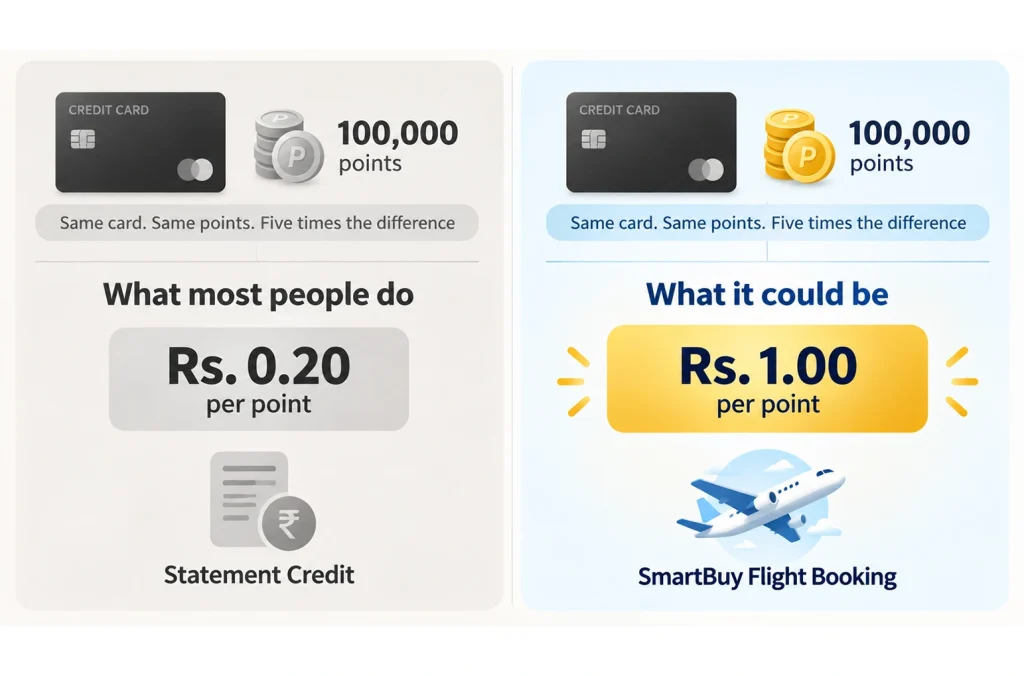
Redeeming HDFC Infinia points for statement credit returns Rs. 0.20 per point. Redeeming the same points for flights through SmartBuy returns up to Rs. 1 per point. That is a 5x difference in value from the same points balance. Most cardholders default to the statement credit because it is the easiest option in the portal, not because it is the best one.
The same pattern plays out across issuers. Axis EDGE points redeemed for product vouchers return Rs. 0.20 per point. The same points transferred to airline partners return Rs. 0.25 to Rs. 0.50. SBI reward points redeemed through the travel catalogue return significantly more than the same points used for merchandise.
The card was always capable of delivering more. The redemption decision was the variable that determined whether it actually did. Before your next redemption, spend five minutes comparing channels. The reward calculator makes that comparison instant across your card’s current redemption options, and the difference between the best and worst option on most cards is large enough to matter.
The Fix is Not a New Card
The instinct when a card stops feeling rewarding is to apply for a new one. A new card means a new welcome bonus, a new feeling of having found something better, and a fresh six months before the cycle repeats.
That instinct is expensive. A new application means a hard inquiry on your CIBIL score. A new card means a new fee structure to evaluate. And if the underlying habits do not change, the new card will feel exactly as flat as the old one by month seven.
The better fix is a structured quarterly check: verify your current earn rate against the card’s updated terms, run your accumulated balance through a value comparison before your next redemption, and ask honestly whether the card’s annual fee is still justified by what it is actually returning. The top credit cards in India comparison is useful here not for switching, but for benchmarking: knowing what the best alternative would return on your spending pattern tells you whether your current card is still competitive or whether a genuine switch is warranted.
Sometimes the card deserves to stay. Sometimes the data says otherwise. Either way, the decision should come from numbers, not from the feeling that something has gone flat.
Frequently Asked Questions
Welcome bonuses and elevated first-spend rates create an artificially high return in the first few months. Once those expire, the card reverts to its base earn rate which is significantly lower, and the comparison becomes far less flattering.
Compare your card’s current benefit structure against the terms from when you applied. Key things to check: earn rates, monthly caps, excluded categories, and redemption value per point. Any of these changing mid-year constitutes a devaluation even if it was not announced prominently.
Almost always travel bookings through the bank’s portal or airline mile transfers. Statement credit and product catalogue redemptions typically return 60 to 80 percent less value per point than travel redemptions on the same card.
At minimum once a year, and immediately after any communication from your issuer about programme changes. In 2026 specifically, multiple major issuers changed caps and earn rates mid-year, making mid-year reviews more important than usual.
Not immediately. Cancelling affects your credit utilisation ratio and average account age, both of which influence your CIBIL score. Audit the card’s current net value first. If it is genuinely costing more in fees than it returns in rewards, then the conversation about closure is worth having.